Hospital Series on Services Part 3 Radiology & Ultrasound
Posted on Friday, November 13th, 2026
Rebuilding and Expanding Radiology Services
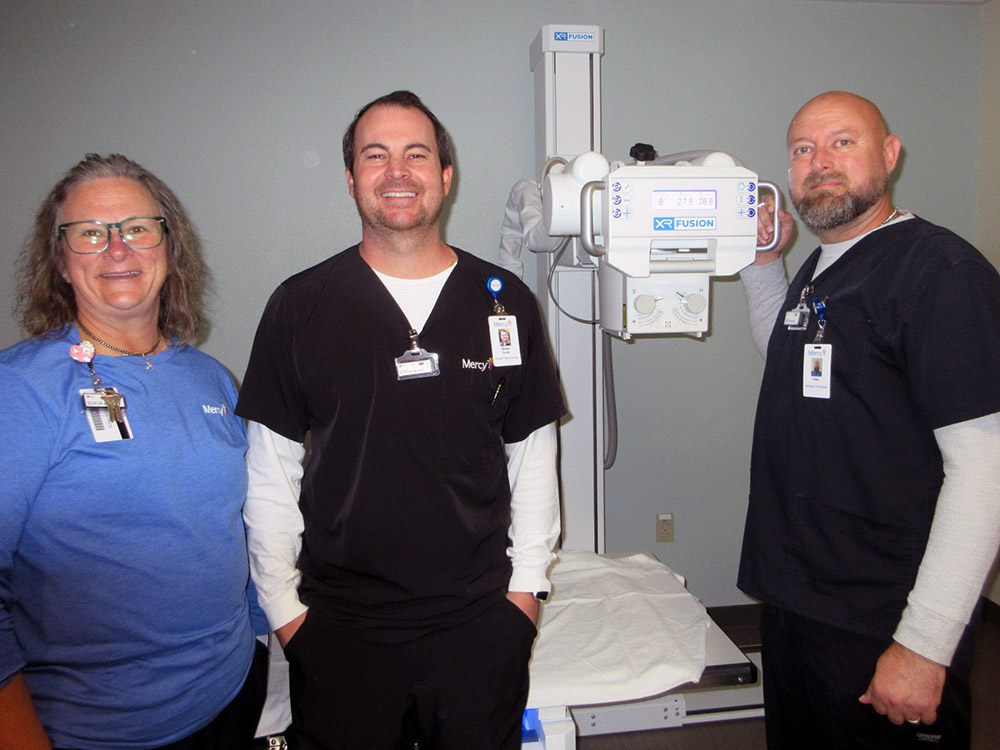
Ultrasound sonographer Jami Buhrmester joins the Radiology
Department's Blake Scott and Alex Langton in showing off
the Fusion X-ray machine on November 3, 2026.
Need an X-ray or CT scan? Mercy Health Love County Hospital has expanded its Radiology Department hours to better serve patients with busy schedules.
The department is now open 7 a.m. to 9 p.m., seven days a week, making it easier for working individuals to receive imaging services before or after work, as well as on weekends.
"It's for everyone's convenience," said Blake Scott, Director of Imaging Services for the hospital, clinic, and Emergency Room. "Many patients can't take time off work, so these extended hours allow them to come in before work, after work, or on weekends for X-rays or CT scans."
Expanded radiology services are available to outpatients from the hospital clinic as well as patients referred by any physician.
All radiology patients should report to the hospital's Emergency Room upon arrival, where they will meet their technologist and be escorted to the radiology suite.
To schedule an exam or verify that your physician's orders have been received, call the Radiology Department at (580) 276-3347, ext. 3 during regular daytime hours. After hours, contact the Emergency Room at ext. 4.
__________________________________________________________________________
Radiology Hours: 7 a.m. to 9 p.m., seven days a week.
Contact: (580) 276-3347
• Radiology Department: Ext. 3
• Emergency Room (after hours): Ext. 4
__________________________________________________________________________
New Lung Cancer Screening Exam
The LDCT or low-dose CT is now available at Mercy Health Love County. The exam is a non-invasive test used to screen for early-stage lung cancer in high-risk individuals before symptoms appear. The test can detect lung nodules, early signs of disease, scarring, infections, and other abnormalities while using significantly less radiation than a standard CT scan.
The procedure is painless, non-invasive, and can be repeated annually.
“For years, patients had to travel to Ardmore for lung cancer screening. Now they can receive that service here,” Scott said.
New and Additional Equipment Planned
Scott and other department heads are actively consulted on the layout of the new hospital. “It’s exciting. We’re helping plan where the radiology department will go, where the windows in it should be located, and how everything will function most efficiently, right down to the placement of the trash can.”
The new hospital will carry GE equipment to include brand new CT scanner (128-slice), X-ray machine, portable X-ray unit, and ultrasound machine. Staff members tested sample models last week. Also a DEXA machine will be installed for the reintroduction of bone density tests. This painless X-ray test measures the strength and mineral content of bones to assess the risk of osteoporosis and fractures.
New hospital construction, on the same site as the old, is pending the awarding of funds from the Federal Emergency Management Agency (FEMA).
The Tornado’s Toll
Following the April 27, 2024 tornado that struck the hospital, radiology services were significantly disrupted. Outpatients were referred to Mercy Ardmore for many imaging studies until services could be restored locally. “The crew of technologists at Mercy Ardmore was great to work with. But we were excited and thankful to reopen,” Scott said.
Today’s Staff and Equipment
Outpatient scans with new X-ray equipment, the XR Fusion DFMT Elite, resumed on February 2, 2026, in a suite of offices constructed for radiology inside the Therapy Building.
“This means clinic providers can obtain immediate X-rays when they suspect a broken bone, pneumonia, or other condition requiring imaging,” Scott said.
CT scans with a new GE Rev Evo 128-slice CT went into operation outside the temporary Emergency Room in August 2025. It serves outpatients and ER patients.
A CT scan can pick up conditions X-rays miss. It has the advantage of detailed three‑dimensional (3D) cross‑sectional images, while a standard X‑ray produces a 2D projection.
The radiology staff has expanded and now includes Alex Langton, Albert Bearden, Sophie Bosseboeuf, Jami Buhrmester, Clay Davis, Marnetta Dorsey, Melissa McMillen, Marcelina Rojas, Ryan Roring, Natalia Segura, and Deborah Wilson. Technologists are on duty in the Emergency Room 24 hours a day and have outpatient hours until 7 p.m. daily for X-rays and CTs.
“It’s wonderful to have a full team of colleagues to work alongside,” Scott said.
Dorsey is the longest-serving technologist, with 26 years. Langton, the newest hire, joined in September and has 18 years of experience. He trained in California. “I love it here. I’m learning a lot and finding patients and colleagues to be very friendly.” he said.
Ultrasound capability is enhanced by a full-time sonographer, Jami Buhrmester. She began operating the hospital’s Phillips Affiniti 70 Ultrasound System on March 30, 2026.
The test is used most often to evaluate liver, gall bladder, pancreas, kidneys, and
carotid arteries.
An ultrasound scanner uses sound waves instead of radiation to create images of organs and structures inside the body. “An ultrasound is the easiest and least invasive of procedures for the patient,” Buhrmester said.
A wide range of tests is available, including abdominal aorta, abdomen, arterial upper and lower extremity, carotid, renal artery, right upper quadrant (RUQ), scrotal, soft tissue, vascular, and venous upper and lower on Monday-Thursday between 8 a.m. and 5:30 p.m. and echocardiograms on Friday between 9 a.m. and 1 p.m.
The typical scan takes 20 minutes. “I try to make the patient as comfortable as possible. Most like to exchange some talk during the test. I try to remember I might be the smile they needed that day,” Buhrmester said.
A Vital Service
Scott estimates that 80% of Emergency Room patients will need imaging. “A CT scan is vital during the ‘golden hour’ for delivering intervention for stroke patients. They need a head CT to determine the need for transport, then an angiogram of the head and neck and carotid artery. A patient with a broken hip will quickly get an X-ray to take with them to the next level of care.”
He joined the hospital in 2012 and trained under Dorsey and department head Rick Stephens, RT, whose experience went back almost to the start of the hospital in 1972.
“Rick took me in like a son and was a very welcoming and encouraging boss. I just like the small town feel of the place, how you can see the same patients over and over and meet them in the community and watch their kids grow up. All the coworkers of Mercy Health Love County are like family. We help each other. I enjoy coming to work each day to serve others in their time of need.”